
Workforce sizing: demand-driven vs. fixed-post staffing
Two regimes coexist in many companies: demand-driven (headcount follows incoming volume) and fixed-post (headcount follows operational structure). Knowing which applies, and when both appear together, is the first step in any serious sizing. In both, typical shrinkage of 25%–35% must be absorbed without SLA disruption.
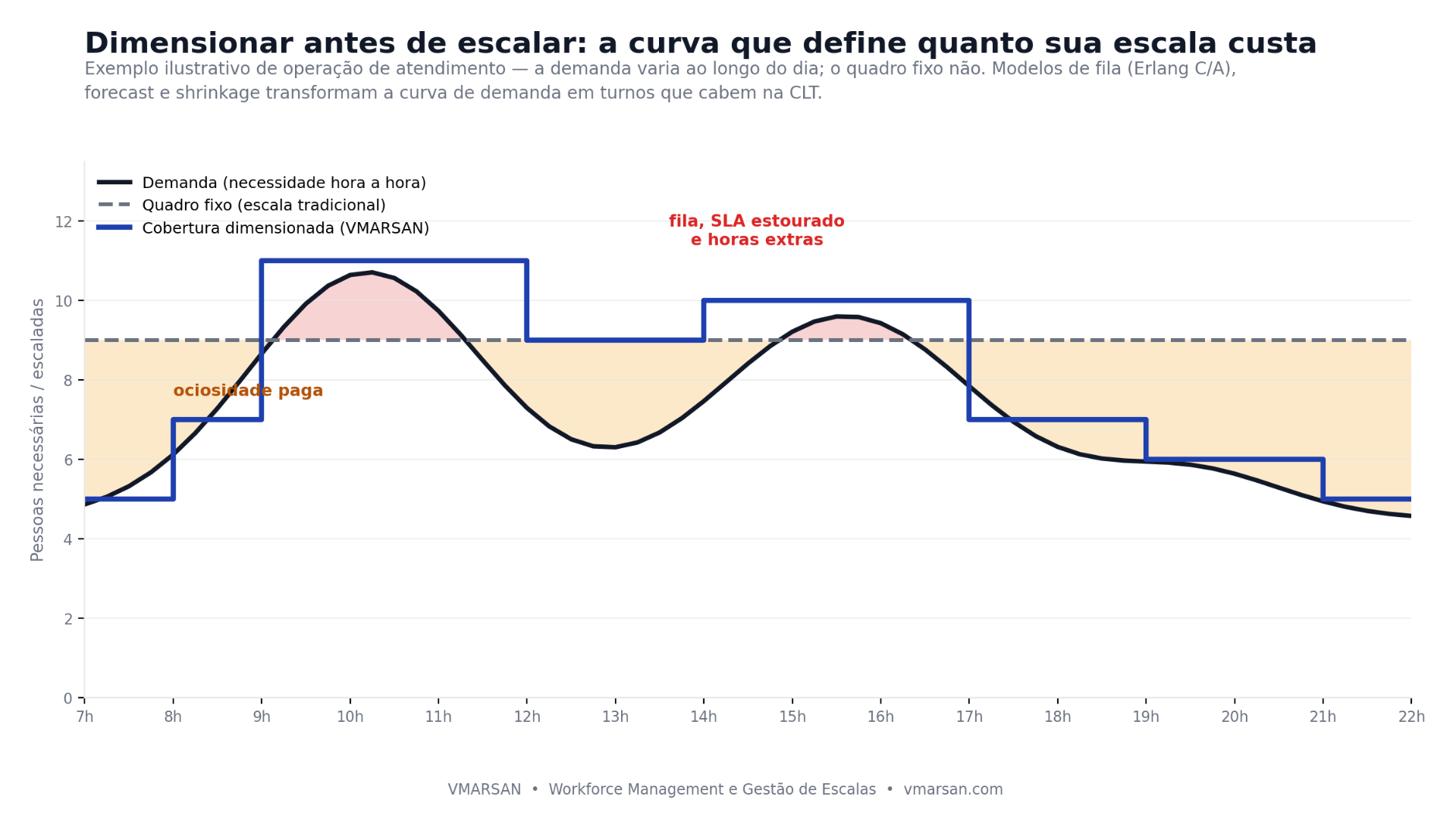
Demand-driven: when the queue dictates the headcount
In receptions, contact centers, retail and customer service, volume varies along the day and the week. Sizing by historical headcount is what generates peak-time queues and idle time in valleys. We size from the real demand curve, using Erlang and shrinkage, and build the shift mesh on top of that.
Queue models: Erlang C and Erlang A
Erlang C calculates the minimum number of agents so that a fraction of demand is served within a target time. Erlang A incorporates the abandonment rate, more adherent to modern contact centers. For field and retail operations, a backlog model with AHT per task type is used.
Fixed-post: when demand does not dictate the headcount
Not every operation forms queues. Hospital beds, production lines, gatehouses and CMEs have fixed posts that require continuous presence. The headcount comes from the structure (posts, shifts and schedule regime), not from the incoming volume. Here an empty post does not create waiting: it creates clinical risk, line stoppage or norm violation.
The fixed-post formula
HC = posts × shifts/day × schedule factor × (1 + shrinkage). The schedule factor depends on the regime: 1.17 for 6x1 and 1.40 for 5x2 in 7-day operations. For 24/7 posts on 12x36, the base is 4 crews per post plus relief.
Shrinkage: the hidden cost
Shrinkage is paid time that does not turn into service: vacations (8.33%), absenteeism (2–6%), training (1–3%), regulated breaks (1–5%), meetings and back-office (3–8%), and tardiness or early leaves (1–3%). It usually sums between 25% and 35%.
When both regimes coexist
Many operations have both regimes at the same time, and treating them with the same method is what generates chronic overtime or structural idleness. In a hospital, the ER is demand-driven, but the nursing post is fixed. The method must be hybrid.
HC = postos × turnos/dia × fator de escala × (1 + shrinkage)
schedule factor = operating days ÷ worked days (6x1 = 1.17 · 5x2 = 1.40) · typical shrinkage = 25%–35%
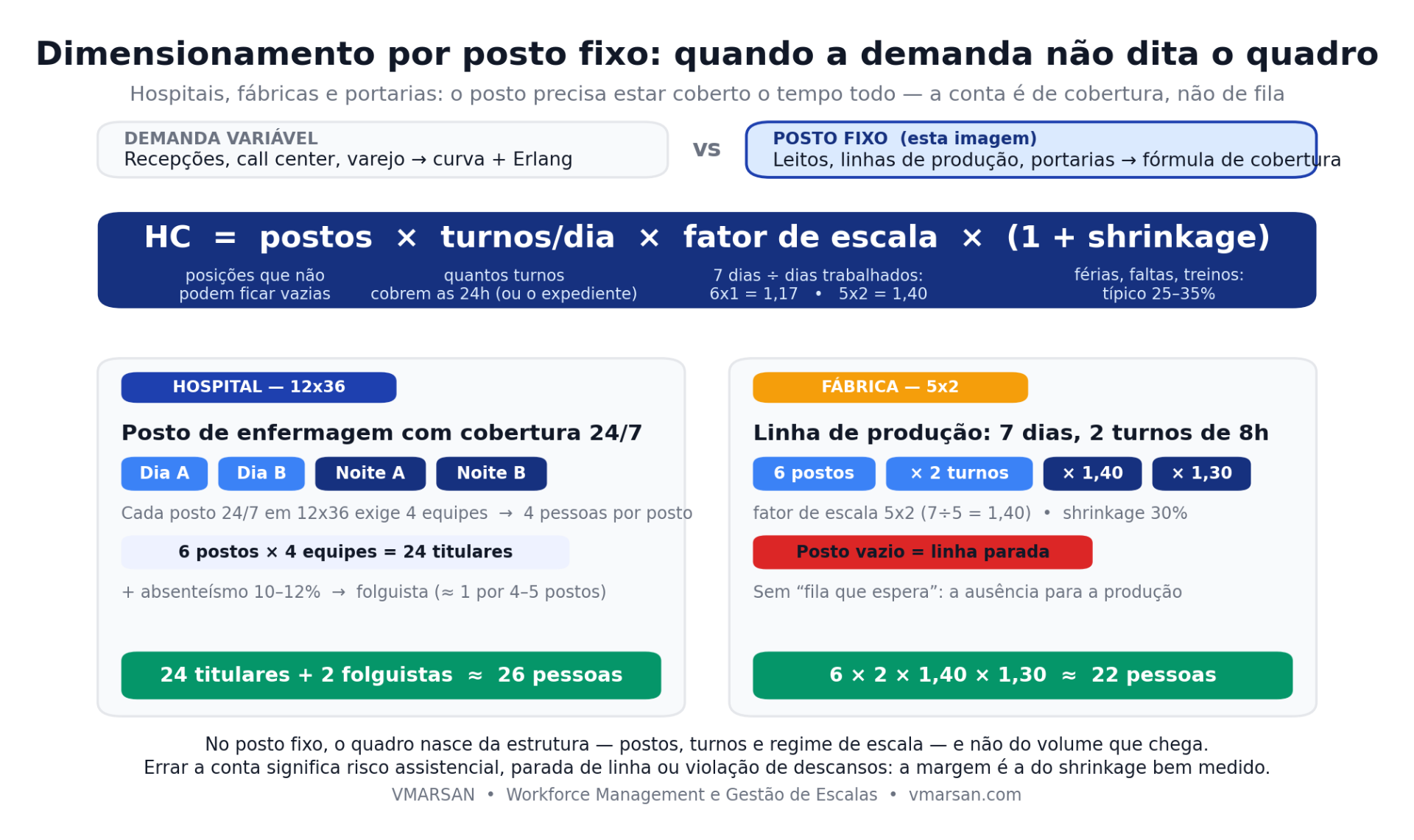
24/7 nursing post with uninterrupted coverage by 4 crews (Day A/B and Night A/B).
Production line 7 days/week with two 8h shifts. No 'waiting queue': absence halts production.
Want a tailored simulation for your operation?
We model your real demand, compare scenarios side by side and deliver an executive sheet with cost, coverage and FTEs.
Talk to a specialistFrequently asked questions
What is shrinkage in workforce sizing?
Paid time that does not turn into service: vacations, absences, training, regulated breaks, meetings and back-office. Usually between 25% and 35%. Ignoring it is the most common sizing mistake.
How do you size a fixed post (no queue)?
HC = posts × shifts × schedule factor × (1 + shrinkage). The schedule factor depends on the regime: 1.17 on 6x1 and 1.40 on 5x2 for 7-day operations.